
The Greenland Ice Sheet sits in the Arctic, from 59-83°N, covering about 80% of the island of Greenland. It has a huge volume of ~2.9 million km3 (which would be equivalent to 7.42 m sea level rise1), and is drained by a series of outlet glaciers, where ice flows constantly to the margin2. The largest outlet glaciers are ice streams.
The outlet glaciers act as ’arteries’ for ice flowing from the interior to the margin. They are funnelled topographically to the ocean, with many narrow, deeply grounded outlet glaciers. Some are buttressed by ice shelves and ice tongues, especially in the north, and thin, well-grounded glaciers2, especially in the east. The outlet glaciers have deeply carved bedrock troughs, and some, such as the North East Greenland Ice Stream, reach far into the ice sheet interior2. There are 280 fast-flowing (more than 100 m per year) marine-terminating glaciers in Greenland2.
Ice is discharged through outlet glaciers
The ice discharged through these outlet glaciers is replaced by snow falling onto the ice surface. However, since the mid-1990s, the rate of ice discharge has exceeded the mass replaced through snowfall, with a sharp increase since the early-mid 2000s (Copernicus).
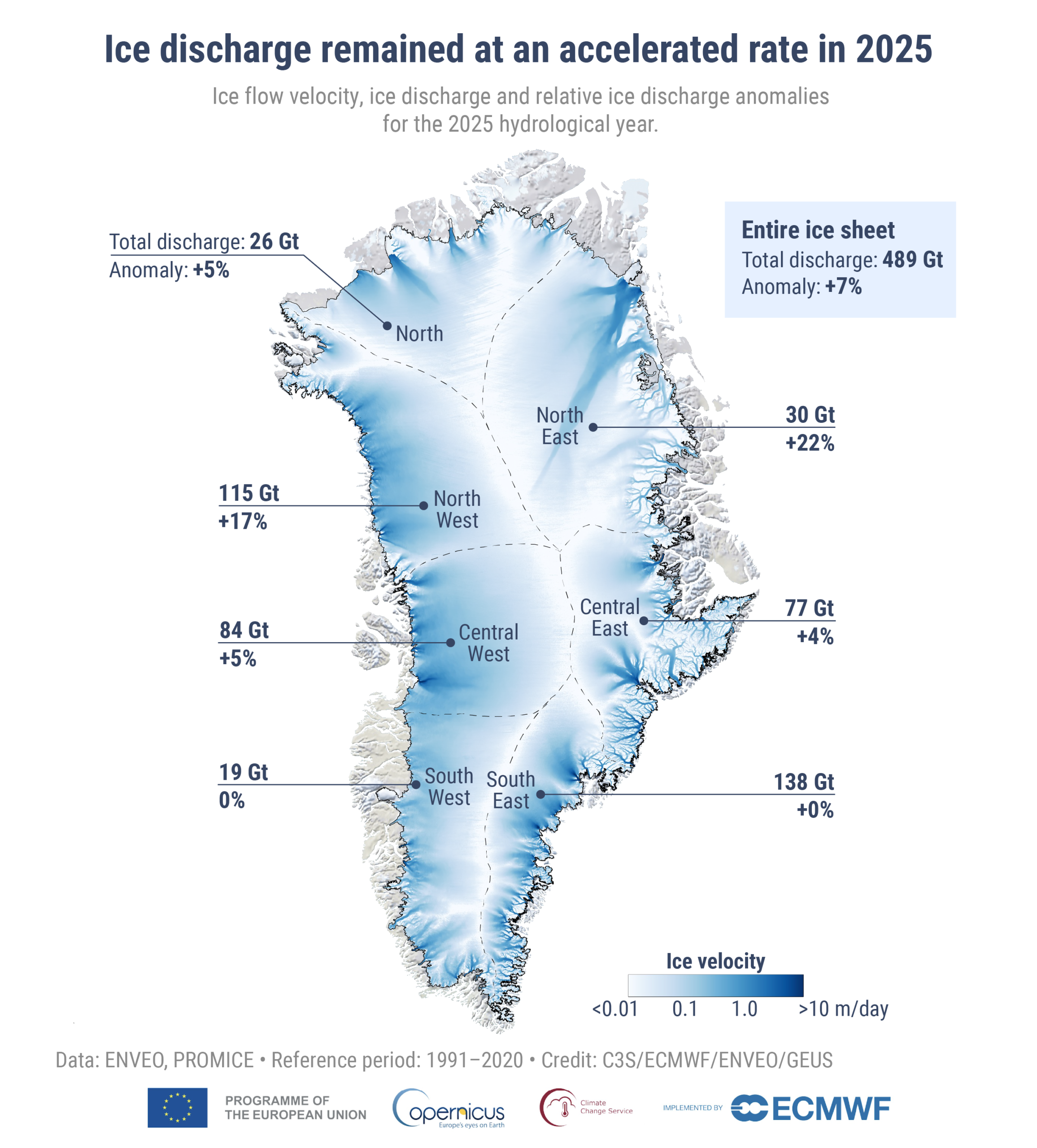
Ice discharge through Greenland’s outlet glaciers is ~500 Gt/year, with large variations between the different outlet glaciers. These outlet glaciers range from 1-30 km wide, 100-2000 m deep, terminate in a range of environments (ice melange, grounded, partially floating, ice tongues), and a range of basal conditions (bedrock, sediments, water)2.
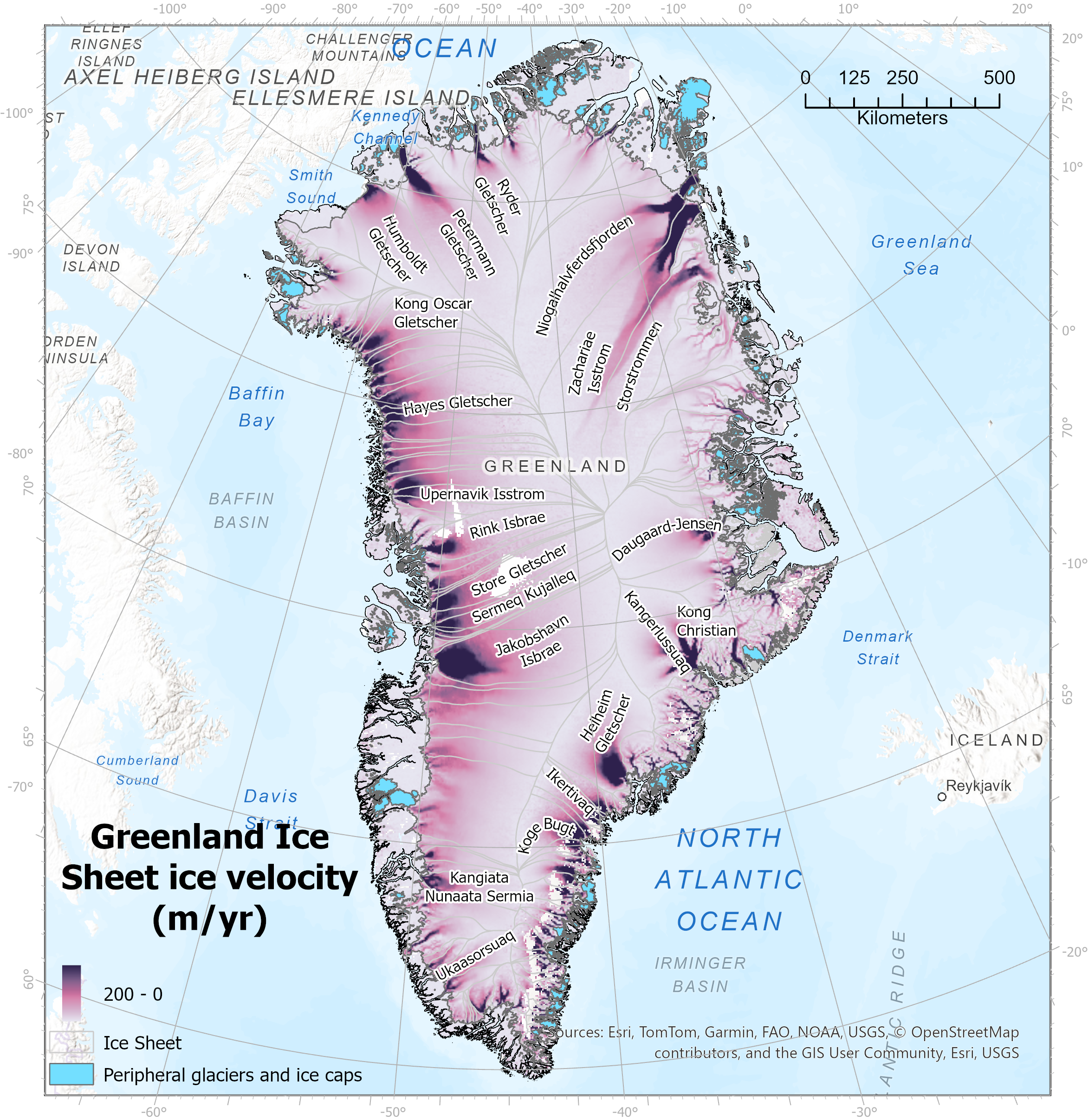
Ice discharge is however focused through only a small number of significant glaciers; in 2025, ice discharge was highest for Sermeq Kujalleq (Jakobshavn Isbrae) (central west sector), Helheim Gletscher (SE sector), and Kangerlussuaq Gletscher (central east sector) (Copernicus). Below we highlight some of the important outlet glaciers in the Greenland Ice Sheet.
Jakobshavn Isbrae
Jakobshavn Isbrae (Sermeq Kujalleq) has been the single largest contributor to mass loss for over three decades4. The outlet glacier has a sea level equivalent of 0.6 m, and is in the central west sector of Greenland. It terminates in Ilulissat Icefjord, which flows into Disko Bay.
The ice stream began to thin and accelerate in 1998, reaching a velocity of 11.9 km/year by 2002, which has been attributed to intrusion of warm water into Disko Bay4. This increased submarine melting of the ice stream’s floating tongue, with its disintegration in May 20034. Following the break up of the ice tongue, Jakobshavn retreated, accelerated and thinned. From 2016 onwards, ice velocity began to slow down, with decreased subsurface ocean temperatures in Disko Bay. The ice stream began to accelerate again in 2018, with the terminus susceptible to changes in ice melange and climate forcing at the ice-ocean interface4.
Helheim Gletscher
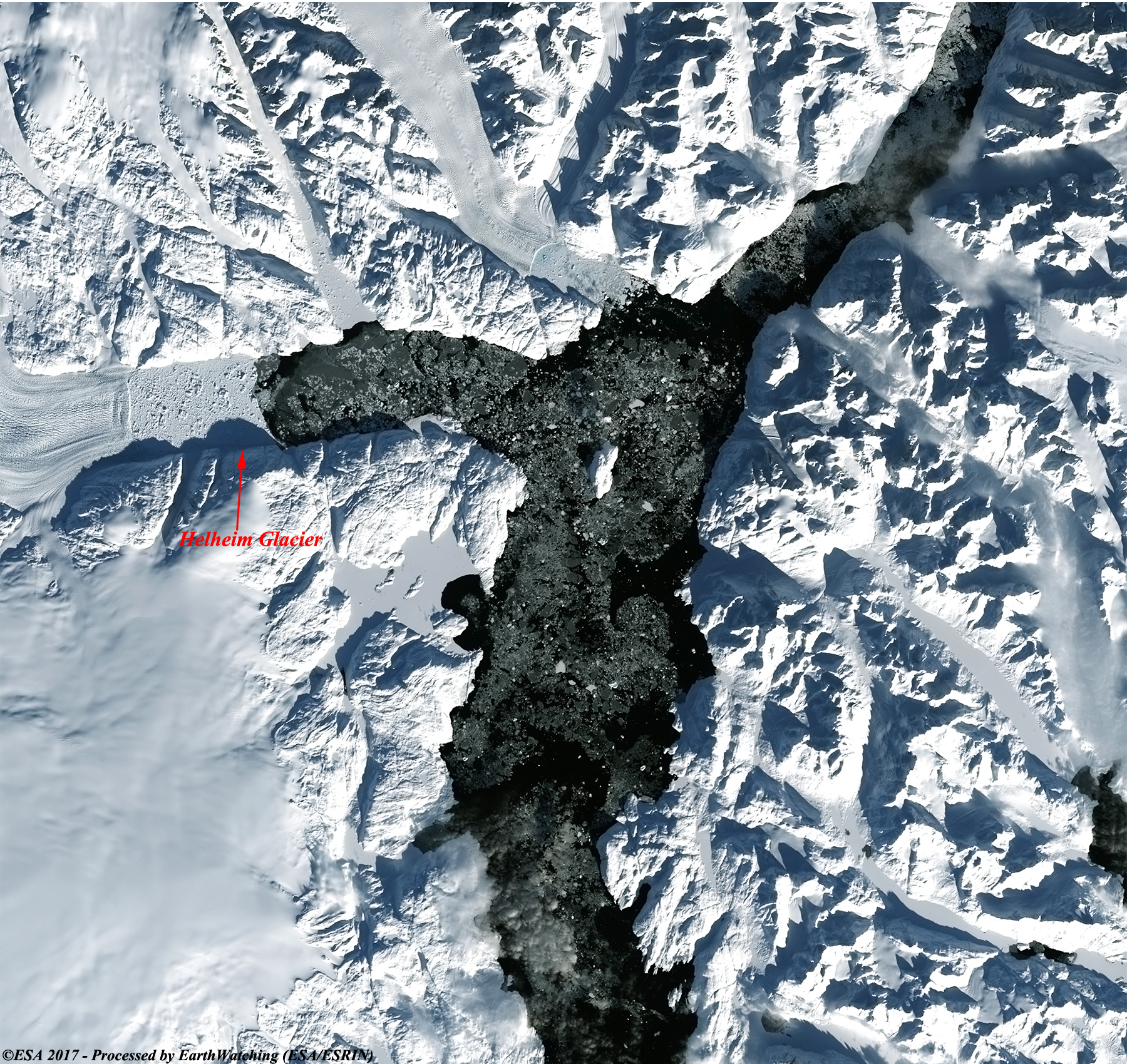
Helheim Gletscher (Helheim Glacier) is a large, fast-moving, marine terminating glacier in southeastern Greenland. It is currently retreating, with a complex dynamic behaviour of periods of fast retreat followed by readvances5. Since the early 2000s, it has retreated by more than 7 km and thinned up to 100 m. It has sped up by 50% since 20045. The terminus is now up to 100 m thinner than in 2005, and the front 5 km is within 25-50 m of flotation6. Further thinning could lead to rapid recession if the front few kilometres start to float.
Kangerlussuaq Glacier
Kangerlussuaq Glacier is one of Greenland’s largest tidewater glaciers, and accounts for 5% of all discharge from the Greenland Ice Sheet. The glacier has been retreating, retreating 5 km between 2016-2018 alone7. Alongside this recession, the glacier also thinned as the ice flow velocity near the terminus accelerated. Retreat has been observed since 1932, when records began, often occurring as retreat events of 5 km or more8.
North East Greenland Ice Stream
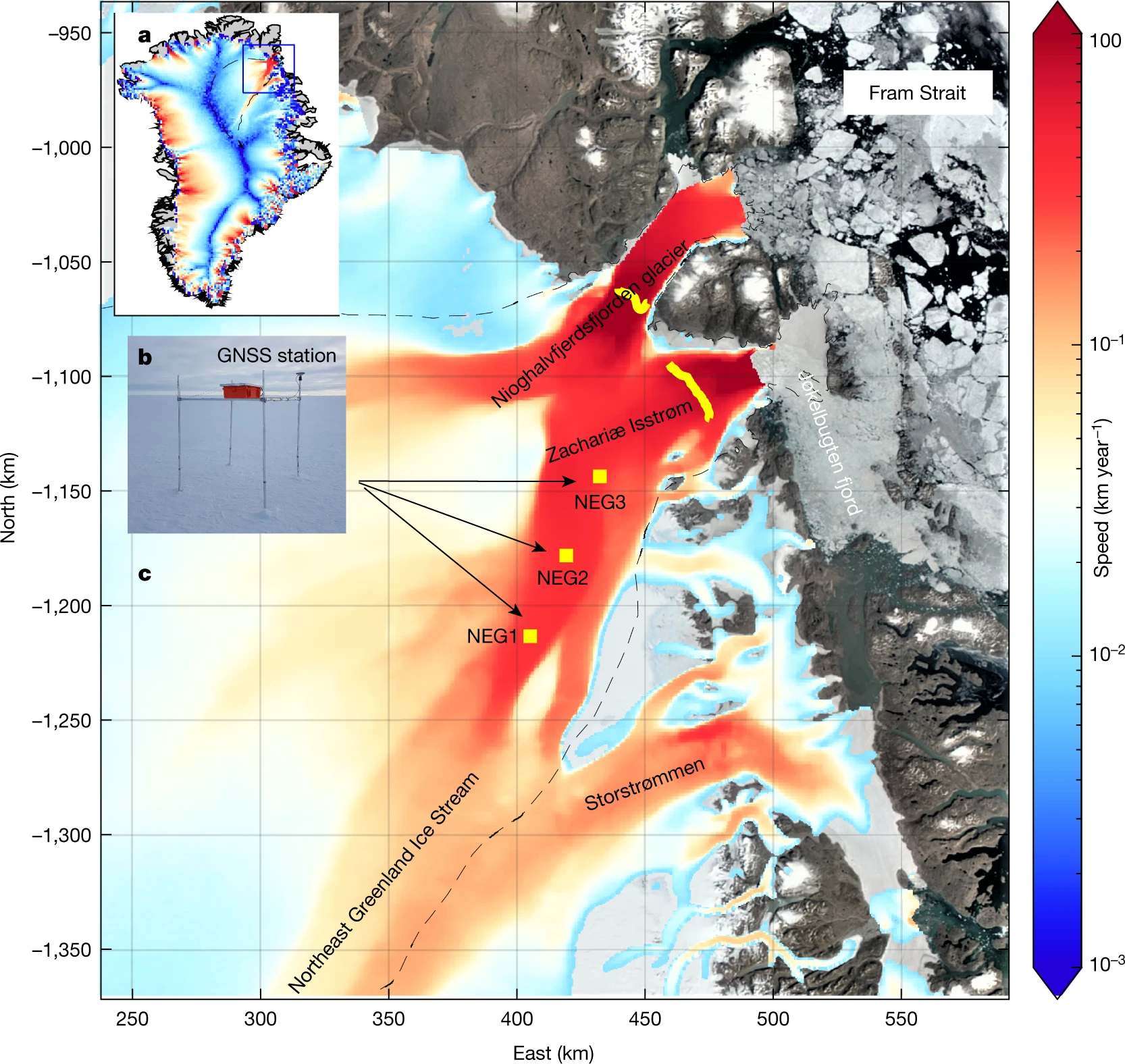
The NEGIS covers some 200,000 km2 and drains through three marine-terminating glaciers: the 79 North Glacier (Nioghalvfjerdsfjorden), Zachariae Isstrom, and Storstrommen. Approximately 8.4% of the entire Greenland Ice Sheet drains through Nioghalvfjerdsfjorden into the ocean. This is the largest outlet glacier of the Greenland Ice Sheet and has the Arctic’s last remaining ice shelf9. The 79North Glacier is currently thinning and retreating, and the glacier is exposed to changes in atmosphere and ocean circulation10.
The NEGIS altogether makes up Greenland’s largest basin, and is vulnerable to rapid retreat and unstable conditions11. Recent speed up and thinning has propagated more than 200 km inland11.
Further reading
Greenland Ice Sheet (Copernicus)