
Current state of the Greenland Ice Sheet
The current Greenland Ice Sheet (GrIS) contains ~3 million km3 of ice. If all of this were to melt, it would be enough to raise the global sea level by 7.42 m1. GrIS contains over 200 major outlet glaciers around its edges, with over half of these glaciers terminating in the ocean (“tidewater glaciers”). These outlet glaciers typically flow at speeds of hundreds of metres per year2.
The loss of ice in Greenland is currently split equally between surface processes, such as melting and runoff into the ocean, and dynamical processes that result in changes to ice flow and the number of icebergs breaking off from the outlet glaciers2. Collectively, these are known as mass loss processes. Mass loss from GrIS has accelerated since 1990, with the rate of mass loss from 2017-2020 estimated at 257 ± 42 Gt per year. A gigatonne (Gt) is the same as 1 trillion kg, so this is a lot of ice, and has contributed to sea levels rising by ~0.71 mm per year since 19903.
Since 2009, the largest contribution to mass loss has been an increase in surface melting and runoff, partly due to increasing temperatures and decreasing cloud cover in the summer3-4. Mass loss rates vary year-on-year, but they are very vulnerable to extreme summer melting, which has become more common in recent years5.
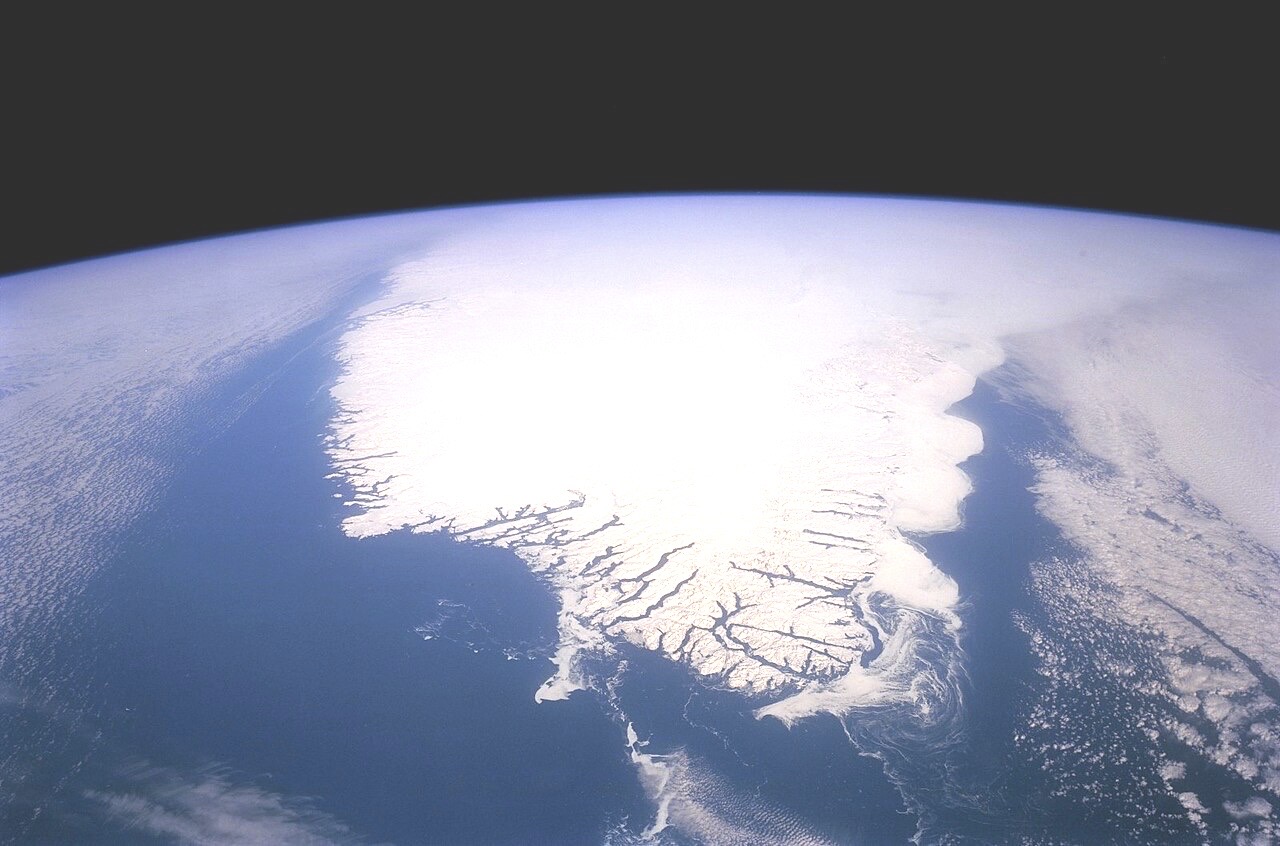
How is the Greenland Ice Sheet changing?
As the climate warms, surface melting will become the main form of mass loss from GrIS6-7. Extreme climate events and the associated extreme melting may become more common, leading to greater total annual melting5. The growth of vast areas of refrozen water within the snow and firn pack, known as ice slabs, will decrease the air content and permeability of the upper ice sheet, also increasing surface runoff (see firn)8. More high-melt years and less energy being available in the snow to refreeze meltwater (“cold content”) could lead to more liquid meltwater being stored within GrIS, acting to further reduce air content and increase surface runoff and surface lake formation9.
However, it might not be all bad news for GrIS. If we manage to cut CO2 emissions to zero, there is potential for GrIS to stabilise, and if enough CO2 emissions are put away in carbon stores (known as sequestration), GrIS could begin to return to its preindustrial extent10! The decision is ours – the future is in our hands.
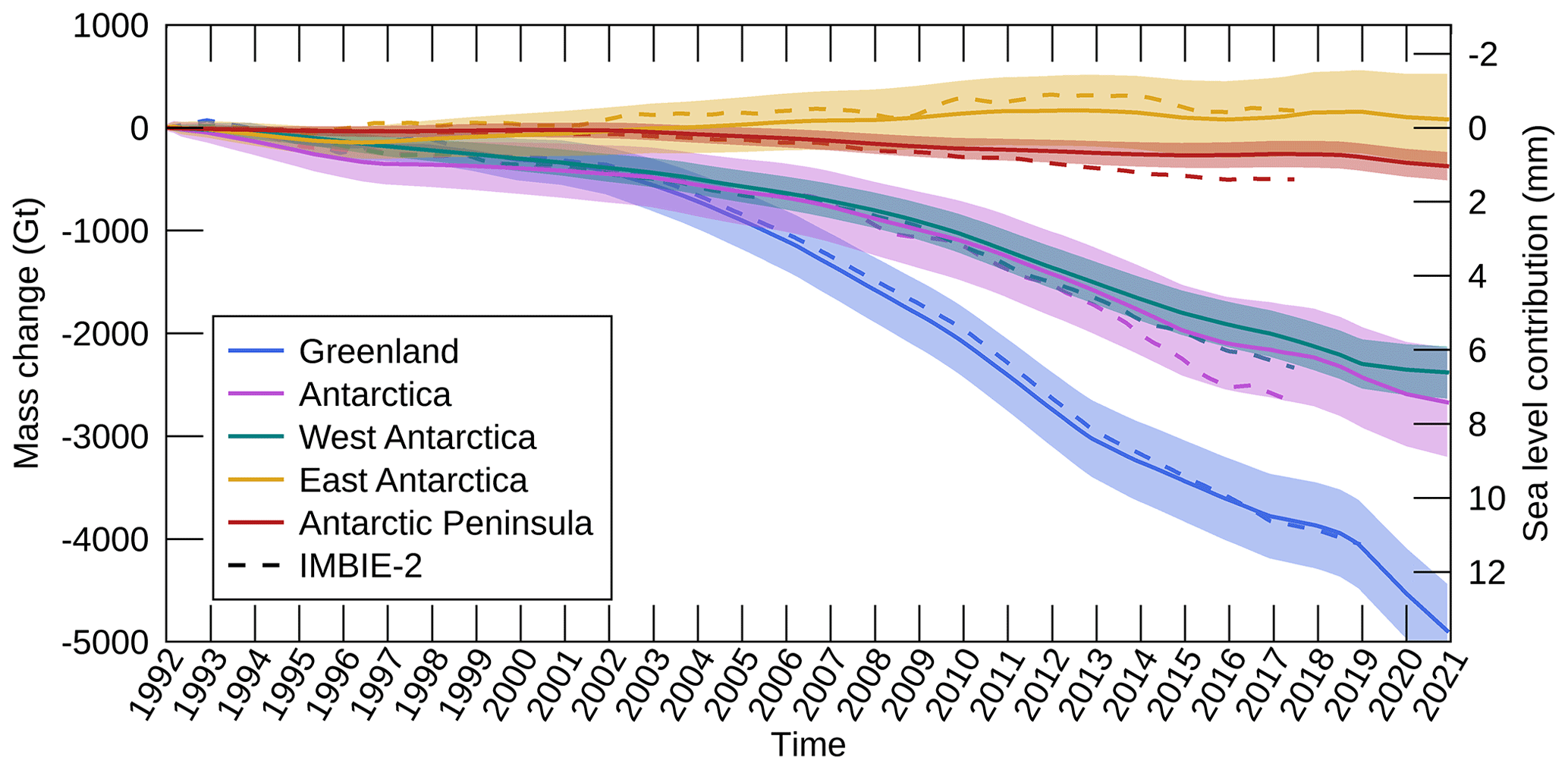
Projections of the future Greenland Ice Sheet
The projected contribution of GrIS to future sea level rise until 2100 ranges from 0.01-0.1 m under low-emission scenarios to 0.9-0.18 m in the highest-emission scenario2. However, it is almost certain that the ice sheet will continue to lose mass beyond 2100, with the greatest mass losses coming from southwestern Greenland, matching current patterns2,7.
The point where the overall mass loss from GrIS cannot be balanced by gains through things like snowfall is sometimes called the ‘tipping point’. Mass loss can likely no longer be rebalanced due to positive feedback loops such as the melt-elevation feedback, where more melting at the surface lowers the surface height of the ice sheet, exposing it to warmer temperatures that further increase melting. Multiple positive feedback loops are occurring on GrIS that will contribute to the passing of this tipping point. It is estimated that this will happen at around 2 °C of warming, which could occur in the coming decades11.
As the climate warms, the GrIS will also shrink in size, with some tidewater glaciers becoming land-terminating, meaning that the number of icebergs breaking away will decrease, and surface processes will become even more important.
A smaller GrIS means more of Greenland will be ice-free, which will cause an increase in summer warming due to the lower reflectivity of the surface (known as albedo)11. More surface melting will likely increase the amount of water that is transported to the bed of GrIS, where the ice rests on bedrock. Increasing water here could cause GrIS to thin and ice flow to speed up, increasing the amount of mass loss at the ice sheet edges12.
About the Author

This article was written by Isabelle Wicks, a PhD student at the Centre for Polar Observation and Modelling at Northumbria University.
I am a PhD researcher at Northumbria University, working with the Centre for Polar Observation and Modelling. I am interested in glacier and ice shelf dynamics, especially their interactions with meltwater and climate. My research focusses on using the MONARCHS model to understand how surface melt on Antarctic ice shelves impacts their stability, and how (near-)surface hydrological networks, including firn aquifers and meltwater storage, develop through time and space. I am also passionate about scientific outreach and getting the next generation of women and girls interested in and excited about polar sciences.