
Globally, glacier melting is getting faster
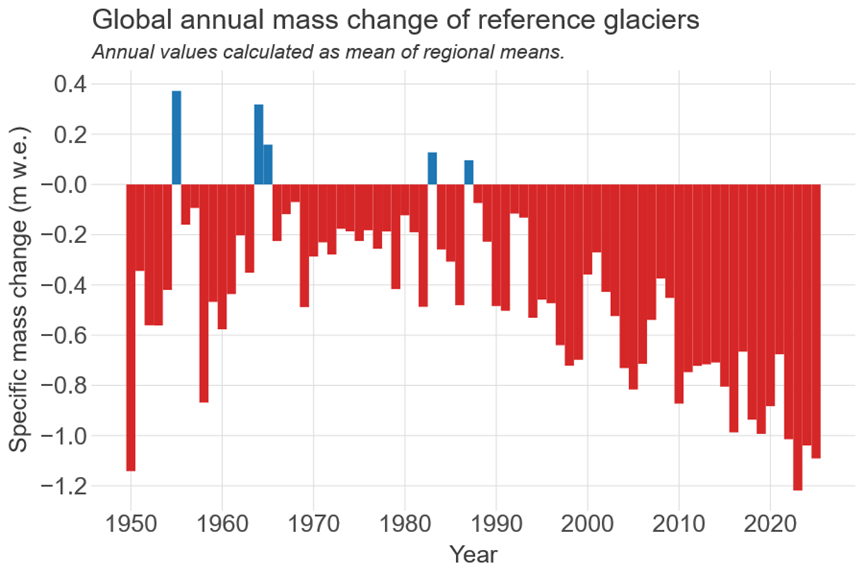
Glaciers and ice sheets are in trouble. Worldwide, glaciers (not including the Antarctic and Greenland ice sheets) lost 273 billion tonnes of ice from 2000-2023, with the second decade (2012-2023) increasing by 36% compared with the first1. In 2025 alone, glaciers lost 408 billion tonnes of ice, equivalent to 1.1 mm sea level rise2.
Since 1975, global glaciers have lost 9,583 billion tonnes of ice (Figure 1). The years 2019, 2020, 2022, 2023 and 2024 represent the highest global glacier mass loss ever recorded3. Global glacier mass loss is accelerating, and glaciers are melting ever faster.
As a result of this crisis, the UN declared 2025 to be the ‘International Year of Glaciers’ Preservation‘ (IYGP). But what does it mean to ‘preserve’ a glacier?
Anthropogenic climate change is driving melt
The cause of this big melt is the globally warming air temperatures4-8, with a clear relationship between glacier mass loss and temperature9. Because glacier response time can span years to multiple decades, glacier shrinkage is a mixed response to both natural climate variability and anthropogenic climate forcings, and a small part of today’s mass loss could be as a result of warming at the end of the Little Ice Age10,11, particularly early in the Twentieth Century.
However, glacier mass loss is accelerating, and numerical simulations firmly indicate that anthropogenic climate change is the driver12-14. Glacier loss is the quintessential casualty of global climate change15.
Future glacier loss depends on global temperatures
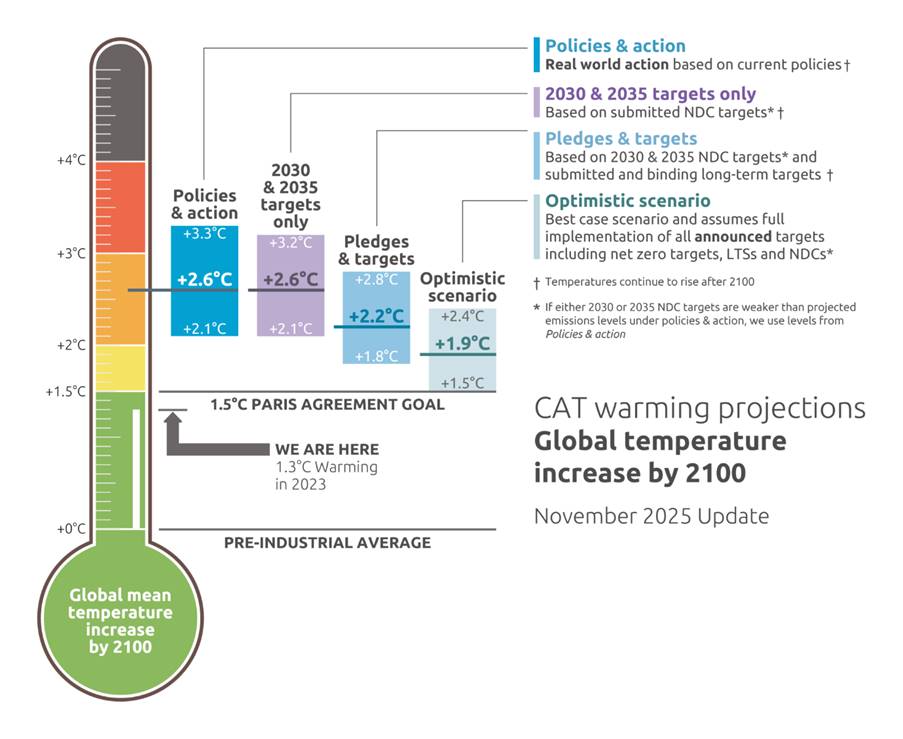
The only proven way to reduce melt is to reduce global carbon dioxide emissions. Mass loss is linearly related to temperature increase, and reductions in temperature reduce mass loss9. If global temperatures reach ~2.7°C above pre-industrial by 2100 CE, as expected based on current climate pledges from COPs9 (see Climate Action Tracker), glaciers will contribute ~115 mm to global sea level rise, and there will be almost complete deglaciation of Central Europe, Western Canada and US, and New Zealand9.
Alternatively, under a more optimistic scenario, keeping global temperatures under 2°C (which is still possible according to the UN Emissions Gap report 202516), glacier mass loss would be reduced, with a sea-level contribution of 98 mm9.
For example, under a warming of 2.7°C, Alaska would be losing about 483 glaciers per year by 2042 CE, and by 2100, 90% of glaciers would be extinct17. In contrast, under a warming of 2°C, 73% of glaciers would be extinct, and 65% under 1.5°C of warming17. It needs to be noted that even if we warmed to only 1.5°C, we’d still see glacier mass loss, because glaciers are currently not in equilibrium with climate, and are shrinking.
Glacier loss even with overshoot followed by cooling
Even if we overshoot 1.5°C of warming and then cool again through some form of carbon dioxide removal, some glaciers will be lost forever18. Glacier runoff will be reduced for centuries if this overshoot occurs, compared with limiting global temperatures to 1.5°C. Emissions reductions are far more effective at retaining our world’s mountain glaciers than overshooting and relying on carbon dioxide removal.
Geoengineering to preserve mountain glaciers?
Technological solutions proposed to reduce mountain glacier melt include wrapping glaciers in geotextiles, making ice more reflective using glass beads, enhancing snowfall through cloud seeding19,20, and making artificial ice reservoirs21.
Reducing melt
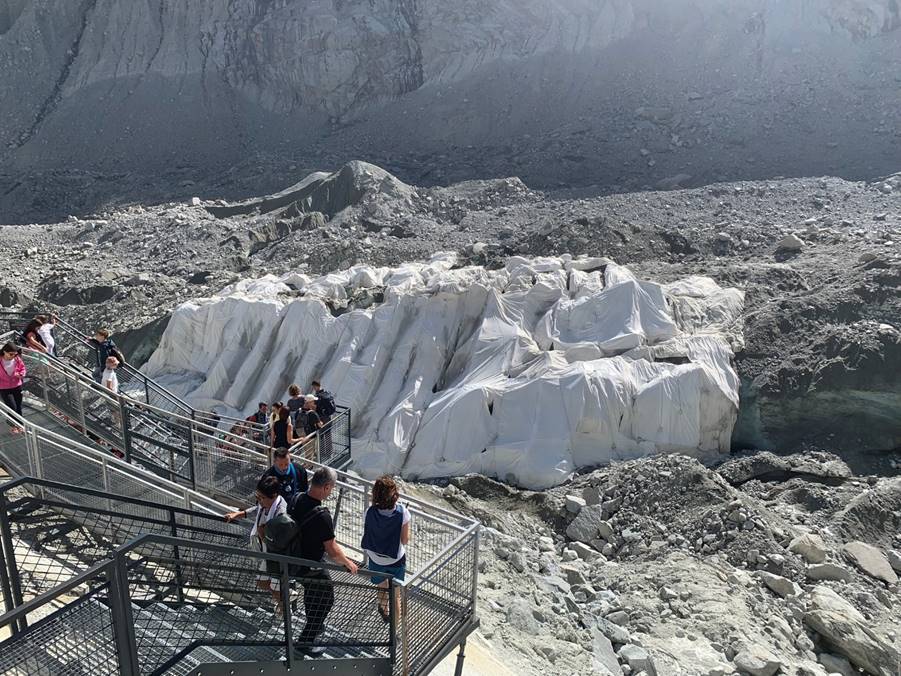
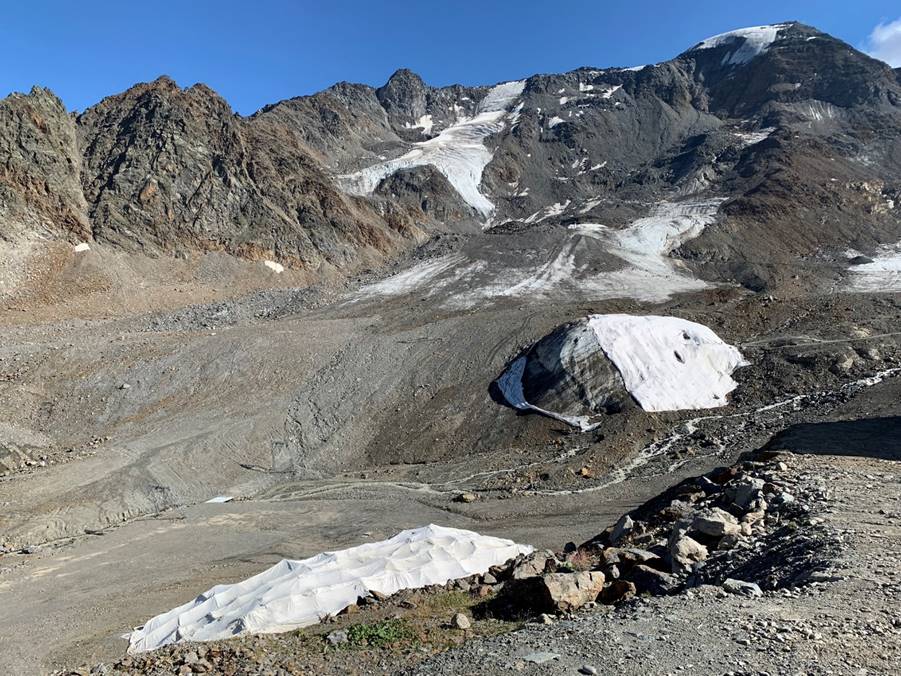
It is increasingly common to see, at European ski resorts, the desperate attempts to preserve snow and ice through the summer by covering it in white tarpaulins, as shown in the photographs below. The tarpaulins are effective for the covered ice, by reflecting solar radiation and reducing heat input from turbulent fluxes22. This can reduce melt by 50-70% underneath the geotextile23-25. They are, however, deeply unattractive!
As well as geotextiles, placing a radiative cooling film over the ice surface can also passively protect ice26.
Increasing accumulation
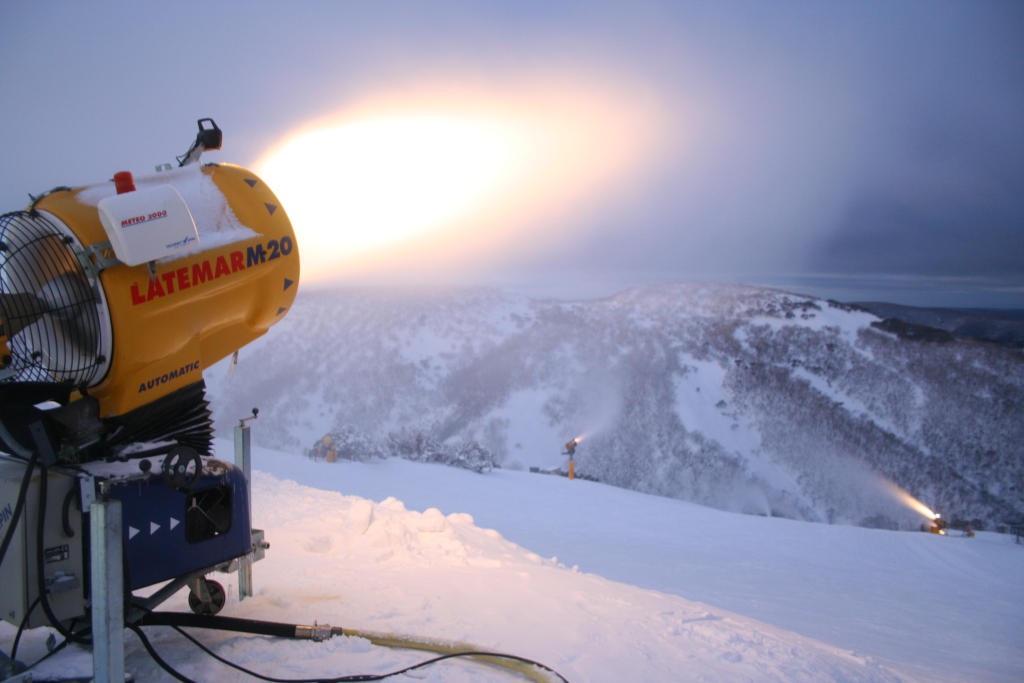
Artificial snow making (as also seen abundantly in many European ski resorts throughout the winter) can add mass to a glacier, increase albedo, and insulate the glacier, reducing melt as well as increasing accumulation24. This can increase the preservation of ice thickness by multiple metres when maintained over years27.
For example, the MortAlive project at Morteratsch Glacier in Switzerland uses snowmaking cables with snow guns, installed above the glacier. Unlike a snow cannon, the snow rope does not require stable ground conditions. This has a positive but limited effect on glacier retreat but could not stabilise the glacier even under the most favourable climate scenario.

Large scale geoengineering
In Chile, glacier ice has even been ‘relocated’ to a new valley to ‘save a glacier’, carried out by a mining company26.
In the Arctic, there are experiments underway to thicken sea ice by pumping sea water onto it. This increases sea ice area and reduces the albedo, reducing melt.
At the biggest possible scale, sea curtains and sea walls have been proposed in Antarctica and Greenland, to prevent warm ocean waters from melting glaciers at the grounding line28-31.
Other, broader, proposals include stratospheric aerosol injection, which injects sulfate particles into the stratosphere to scatter and reflect solar radiation20.
Cloud seeding provides centres for drops and ice crystals to form on. Silver iodide can help orographic clouds form in mountain regions, which can increase snowfall and enhance snowpacks.
Building artificial ice reservoirs
Rather than ‘preserving’ glaciers, you can freeze towers of water in the winter, and let it melt in the summer. In High Mountain Asia, artificial ice reservoirs (AIRs, also known as Ice stupas) have been used to enhance water security32.
In Ladakh, in the Indian Himalayas, stream water is stored sprayed into the air in winter, where it freezes. It is then stored in large ice towers through the winter, and the meltwater generated in the spring used for irrigation33. Here, these artificial ice reservoirs have been effective in the region for reducing seasonal water scarcity, with considerable local benefits21.

Challenges for glacier geoengineering solutions
Local solutions to a global problem
The biggest issue with these geoengineering fixes is that they are a local solution to a global problem. Saving just one bit of a glacier, as seen in the photographs above, does little to protect the majority of the glacier, or those around it, from melt.
Protecting just one glacier may help save an economically or hydrologically important glacier from melting quite so much in the melt season, but does little to protect the wider area. Geotextiles and tarpaulins cover only a tiny portion of the glacier; just the area above the glacier grotto at Mer de Glace in the photograph above, and at Rhone Glacier15. In Switzerland, just 0.02% of glacier area is covered by geotextiles25.
This is unscalable; glaciers are large, and covering just one small part of it has an imperceptible impact on glacier melt. To achieve a noticeable impact, you would need to cover thousands of glaciers across their entire surface, and maintain this over decades22, in inhospitable, high, remote and often challenging environments. As the glaciers flow downstream, the geotextiles need constant maintenance. This may be possible to a limited extent within European ski resorts, but not by small communities with limited infrastructure in, for example, High Mountain Asia.
Artificial ice reservoirs as used in Ladakh have been challenged as an effective climate adaptation strategy more broadly; they are a site-specific water conservation strategy21. They are very sensitive to climate conditions, with climatic variability, natural hazards and socioeconomic settings challenging a broader take up21. They have a limited storage volume, which restricts their usefulness in strong drought conditions24.
Environmental cost
Many geoengineering solutions have adverse impacts. For example, ice sheets and glaciers are themselves habitats, with a biome mainly composed of microorganisms34. Silca-based glass microspheres spread on ice may slow melting, but can harm algae and cyanobacteria34. In sea ice, glass beads pose a risk of ecotoxicity35.
Reflective geotextiles can reduce ice melt, but release microplastics into the environment, which make their way into the food chain. Larger fibres can entrap animals. Harsh weather and steep topography will degrade geotextiles and facilitate their input as contaminants into the hydrological cycle22. Radiative cooling films may be a greener alternative as they are biodegradable26.
Installing underwater barriers near glacier grounding lines would affect marine productivity and fisheries31. This would likely have far-reaching detrimental marine environmental consequences35.
Artificial snow making demands substantial water and energy, and water extraction may impact water scarcity in arid regions24. The energy demands contribute to carbon emissions.
Cloud making for increasing local precipitation can lead to the accumulation of chemicals in snowpacks24.
Financial cost
A major limitation of many of these mountain glacier geoengineering solutions is that they are expensive, unscalable, and are inequitable in the way in which communities can respond to climate change. Huss et al.25 note the high financial cost to preserving small areas of glacier ice with geotextiles, and suggest that, while this may be appropriate for very specific areas such as tourist sites, the solution is not affordable. Covering all glaciers in Switzerland with geotextiles would cost US$1-2 billion, annually22,25. Artificial snow making on glaciers is also expensive, with a high environmental cost.
Mountain communities may well want to implement the local challenges above, particularly after weighing up the economic, environmental and logistical barriers, and may mitigate glacier loss locally. However, these techniques remain inequitable, and not accessible by all communities.
Governance
Glacier protection strategies can result in a strong visual alteration of the landscape, and pose significant ecological, touristic and economic risks. There is a need for community participation and transparent governance, with plans for long-term maintenance and management24. Visual impact assessments, participatory planning and environmental impact assessments are needed.
Enhancing in situ glacier preservation requires a clear governance structure, to preserve glacier existence, cultural, hydrological and economic value24. This could include improved glacier protection laws, and designation of new protected areas. However, Argentina’s ground-breaking glacier protection law was recently loosened.
Preserving glaciers by cutting carbon emissions is the only effective answer
Finally, these approaches are backward-looking, not forward-looking. Seeking to ‘preserve’ glaciers, for nostalgia15, or for economic reasons, does not protect them going forward in any meaningful sense, and potentially blocks bigger solutions15. The mountain glacier preservation strategy examples discussed here have minimal impact on glacier-wide volume loss, with significant challenges to implementation and strong visual, economic and environmental consequences.
The most effective way to preserve global glaciers at scale remains to curb carbon emissions. Reducing global temperatures by 2100 CE would preserve more glaciers, in more places, than any other intervention9,10,17. As Rounce et al. said so eloquently, “every increase in temperature matters”9.
Further reading
Safeguarding the polar regions
Global disparities in fighting climate change
Ice stupas picture essay
Artificial snow can slow but not stop glacier melt, says study