
What is blue ice?
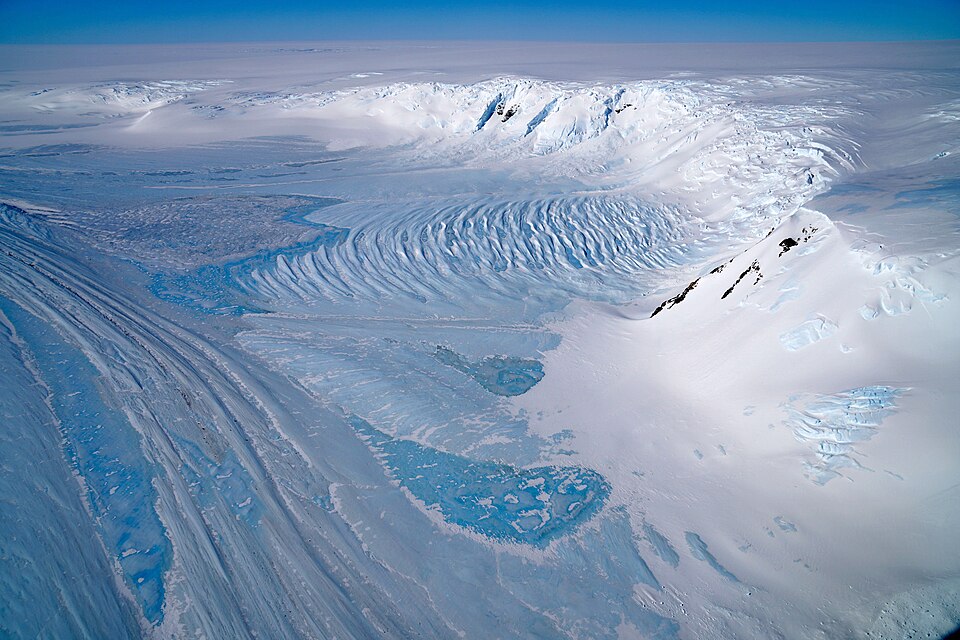
Most the surface of Antarctica is covered in snow and firn (snow that has survived at least one melt season) (see firn). However, in mountainous regions and around the coast of Antarctica, areas of blue ice can be found1. Most blue ice is very old glacial ice that has been exposed at the surface through the removal of the overlying snow and firn by wind erosion1-3. It is very dense and has very little air trapped inside; this lack of air causes more light to be absorbed, especially at the red end of the spectrum, leading to its distinctive blue colour4.
Blue ice in Antarctica is very rare, only covering ~1% of the surface of the Antarctic continent1,2,5. Regions of blue ice can vary in size from hundreds of square metres to thousands of square kilometres6.
How and where does blue ice form?
There are two ways that blue ice can form: wind erosion and melt processes1.
Katabatic winds
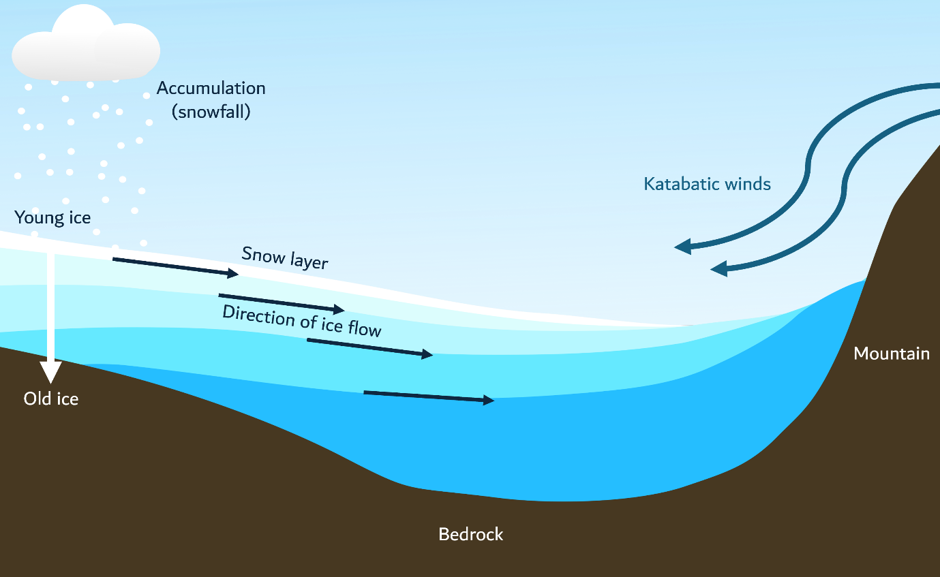
Wind-eroded blue ice is found in mountainous and high-elevation areas of Antarctica, where winds flowing down a mountain (katabatic winds) blow away snow and firn cover year-round and smooth out the ice surface, meaning that it is very difficult for any falling snow to stick to the ice1.
Katabatic winds occur when cold and high-density air in high elevations, such as at the tops of mountains, flows into warmer and lower-density air below. These flows are driven by gravity due to the density differences between cold and warm air6. In these windy regions, energy from the sun and katabatic winds during the Antarctic summer also cause snow to transform directly to water vapour (“sublimation”), meaning it cannot fall onto the ice to begin forming a snow cover1,7,8. However, these processes seem to be very localised, and these blue ice areas do not change size easily when local climate conditions change1.
Strong surface melt
The other way blue ice can form is through melting. Sloping surfaces in some coastal regions of Antarctica are suitably windy and warm enough to sustain conditions for persistent surface melting. Repeated cycles of melting and refreezing cause this blue ice to form. Liquid water may also be present here, which can lower the reflectivity of the surface (known as the albedo) (see surface energy balance) and lead to further melting1. These areas vary in size much more with changing climate conditions.
Nearly one-third of all blue ice in Antarctica is found on the lower portion of Lambert Glacier and nearby Amery Ice Shelf5, where supraglacial lakes form. The water melts in the blue ice areas and then collects on the flat floating Amery Ice Shelf. The rest is distributed around the coastal and mountainous regions of Antarctica but tends to be concentrated in three other regions: Victoria Land, Dronning Maud Land, and the Transantarctic Mountains8.

Why is blue ice important?
Lower albedo promotes surface melt
Blue ice areas are very interesting to glaciologists, as they tend to be warmer and windier than their surroundings9. They also have a much lower albedo than fresh snow or young ice, meaning they absorb more solar radiation and can increase the amount of surface melting in a region, leading to the formation of lakes and meltwater streams on the surface of the ice10. This meltwater can collect and pond on ice shelves, such as Amery Ice Shelf11.
Past climate archive
When observed over long periods of time, areas of blue ice tend to be very stable9. However, both types of blue ice are very sensitive to climate change, and can be used as a climate indicator for the wider Antarctic continent2,12. Surface cores taken from areas of wind-eroded blue ice can contain lots of information on past climates and can be drilled in areas where deep ice cores are not currently available7, and so are very useful for climate scientists looking to study past Earth climates.
Meteorite traps
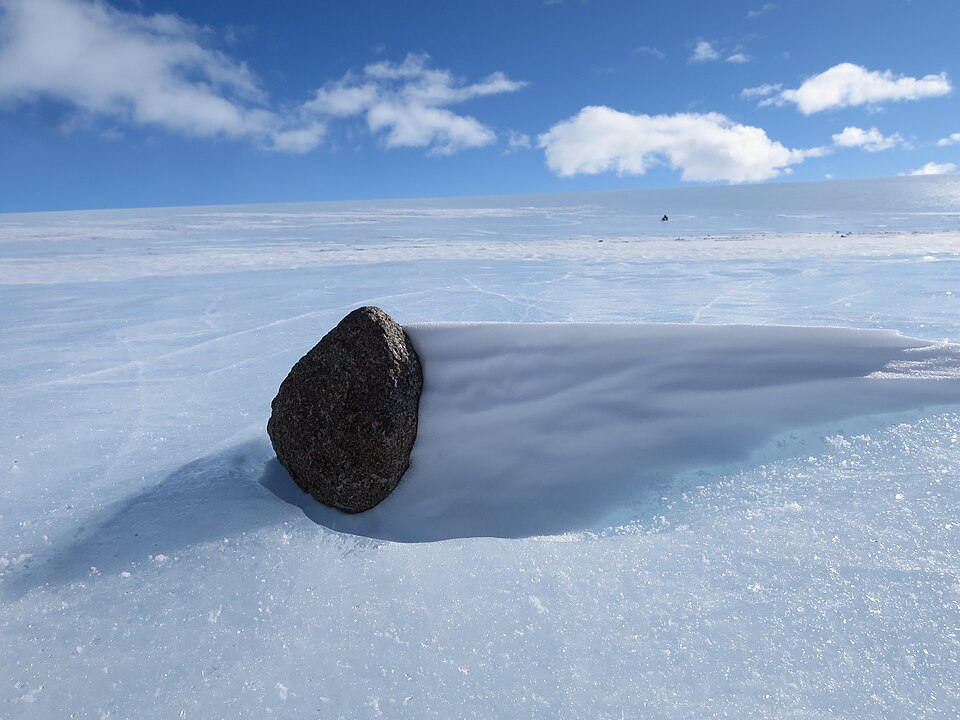
Blue ice areas can also act as traps for meteorites that landed on Earth millions of years ago, preserving them and bringing them to the surface, which can be used studied planetary scientists looking to understand our universe and the origins of life on Earth5,12!
Further reading:
Blue ice is an exciting topic with a lot of potential for scientific research! I recommend these articles for further reading if you would like to know more:
Bintanja, R. (1999). On the glaciological, meteorological, and climatological significance of Antarctic blue ice areas. Reviews of Geophysics, 37(3), 337-359. https://doi.org/10.1029/1999RG900007
Sinisalo A., & Moore J. C. (2010) Antarctic blue ice areas – towards extracting palaeoclimate information. Antarctic Science, 22(2), 99-115. https://doi.org/10.1017/S0954102009990691
Bintanja, R., & van den Broeke, M. R. (1995). The climate sensitivity of Antarctic blue-ice areas. Annals of Glaciology, 21, 157–161. https://doi.org/10.3189/s0260305500015755
Lenaerts, J. T. M., Lhermitte, S., Drews, R., Ligtenberg, S. R. M., Berger, S., Helm, V., Smeets, C. J. P. P., van den Broeke, M. R., van de Berg, W. J., van Meijgaard, E., Eijkelboom, M., Eisen, O., & Pattyn, F. (2017). Meltwater produced by wind-albedo interaction stored in an East Antarctic ice shelf. Nature Climate Change, 7(1), 58–62. https://doi.org/10.1038/nclimate3180
About the Author

This article was written by Isabelle Wicks, a PhD student at the Centre for Polar Observation and Modelling at Northumbria University.
I am a PhD researcher at Northumbria University, working with the Centre for Polar Observation and Modelling. I am interested in glacier and ice shelf dynamics, especially their interactions with meltwater and climate. My research focusses on using the MONARCHS model to understand how surface melt on Antarctic ice shelves impacts their stability, and how (near-)surface hydrological networks, including firn aquifers and meltwater storage, develop through time and space. I am also passionate about scientific outreach and getting the next generation of women and girls interested in and excited about polar sciences.